Mohamed EddaoudiDesigning the space inside matter.

Mohamed Eddaoudi studies how molecular building blocks can form porous materials that capture and separate molecules.

Ibn Alhaytham Distinguished Professor of Chemistry, KAUST
Chair, Advanced Membranes and Porous Materials Platform

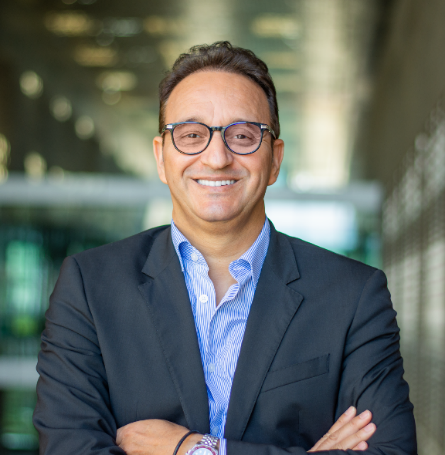
Portrait of Mohamed Eddaoudi, smiling, in glasses and a dark jacket, arms folded.

Reticular chemistry

Pores by design

Molecular building blocks link into ordered frameworks. Their geometry fixes the architecture, the architecture fixes the empty space, and the empty space decides which molecules can enter.

This is MOF-5, one of the first stable, highly porous metal–organic frameworks (MOFs). Zinc–oxygen clusters (teal) are joined by benzene-based linkers. Drag it to turn it.

Cut away the front of the crystal and the space inside appears. The highlighted sphere is a pore: empty, open to its neighbors, and sized by the building blocks around it.

MOF-5 in idealized geometry built from its published structure.

Discoveries

What the work has changed

MOF-51999IRMOF series2002One net. Different linkers.
Different pores.

1999 · 2002

Frameworks that keep their pores

The problem
Porous crystals were hard to trust: many lost their structure once the molecules inside them were removed.
The contribution
In 1999 Eddaoudi co-authored the paper on MOF-5, which stayed crystalline and porous when emptied. In 2002 he was first author of the isoreticular study: one net, different linkers, a series of frameworks with different pore sizes and chemistry, tested for methane storage.
Why it matters
Pore architecture became a design choice rather than a lucky outcome.

The 2025 Nobel Prize in Chemistry went to Susumu Kitagawa, Richard Robson and Omar M. Yaghi for metal–organic frameworks; MOF-5 features in the ceremony speech. Eddaoudi contributed to the foundational research behind the recognized field.

With Hailian Li, Michael O’Keeffe and Omar M. Yaghi

gas mixturewhat is taken uppore window
Propylene (one double bond)Propane (single bonds only)

Schematic of the outcome reported for KAUST-7 (NbOFFIVE-1-Ni) in laboratory mixed-gas adsorption at atmospheric pressure. Not to scale; not the crystal structure.

2016 · 2018

Separating molecules that look almost identical

The problem
Propylene and propane are so alike that parting them takes energy-intensive processing.
The contribution
At KAUST, Eddaoudi’s group built a fluorinated MOF, KAUST-7, whose pore opening is fixed by bulky niobium-oxyfluoride pillars. In the laboratory it took up propylene and excluded propane. A 2018 paper with William Koros’s group carried framework selectivity into mixed-matrix membranes.
Why it matters
Pore design aimed at a named industrial separation. The step from crystal to plant is still open.

With Amandine Cadiau, Karim Adil, Youssef Belmabkhout, William Koros and colleagues

Merged nets2024Single crystal to single crystal2026Design before synthesis.
Change after it.

2024 · 2026

Changing a crystal without destroying it

The problem
Planning structures with several kinds of building unit, and altering a framework after it is made, are both hard to do on purpose.
The contribution
A 2024 Science paper sets out how nets can be merged into multicomponent structures systematically. A 2026 Nature Chemistry paper reports editing a MOF by removing ligands while it remains a single crystal.
Why it matters
More of a framework can be designed on purpose, before and after synthesis.

With Hao Jiang, Aleksander Sapianik, Vincent Guillerm, Michael O’Keeffe and colleagues

Perspective

Current questions

  1. How do we design for a separation, rather than for a structure alone?
  2. How can the molecular selectivity of a crystal be carried into a membrane that can be made, shaped and used?
  3. Where is the gap between an excellent material and a functioning process: stability, manufacturability, cost?

People

Research leadership and training

Eddaoudi’s group at KAUST has trained doctoral and master’s students and research scientists since 2009, after seven years at the University of South Florida. His first KAUST doctoral student graduated in 2014. Current members are listed on the research group website.


Recognition and recent work

Selected highlights

  • PositionIbn Alhaytham Distinguished Professor of Chemistry, KAUST
  • FellowshipFellow of The World Academy of Sciences, elected 2026
  • CitationClarivate Highly Cited Researcher, annual lists since 2014

Contact

Start a conversation

Scientific collaboration

For research partnerships and joint work on materials and separations.

mohamed.eddaoudi@kaust.edu.sa

Speaking and media

Biography, portrait and speaking topics are on the Talks & Media page.

mohamed.eddaoudi@kaust.edu.sa

Prospective researchers

Please see the group’s recruitment information before writing.

Research group site ↗